
The Hidden Cost of Being the Best Chef in the Kitchen | Culinary Business Growth
You built your business because you’re good at what you do. Maybe really good.
You’re the one who knows exactly how the dish should taste. You can spot a problem before anyone else even notices it. Your clients ask for you by name. And when something goes wrong? You’re usually the person who can fix it fastest.
That technical skill probably helped build your culinary business.
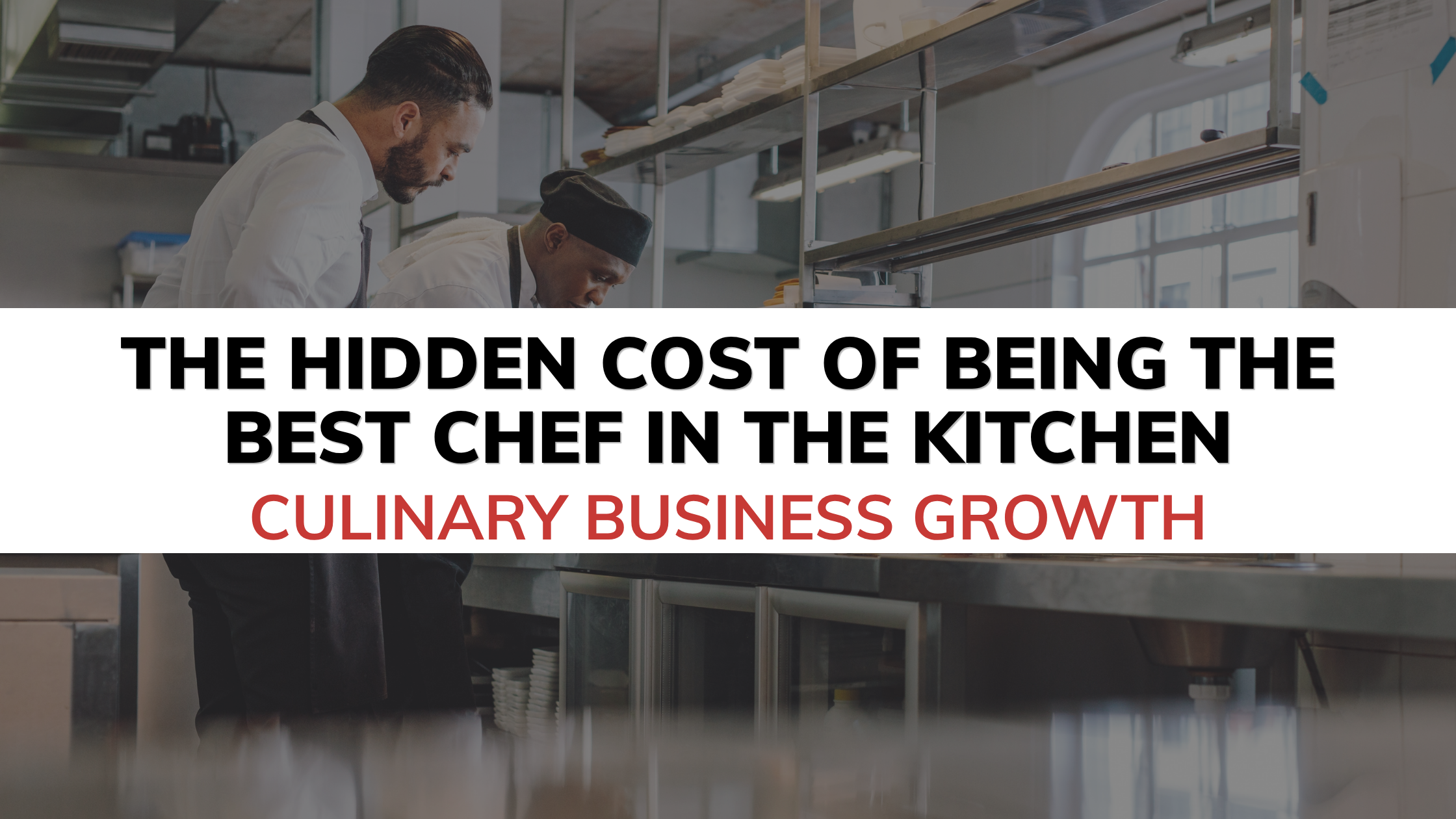
But at a certain point, being the best chef in the kitchen can become the very thing keeping your business from growing.
Because if everything still depends on you, you haven’t built a business that can scale. You’ve built a business with a bottleneck.
And unfortunately, you’re the bottleneck.
When Being the Best Becomes Expensive
In the early days of a culinary business, doing everything yourself makes sense.
You cook. You answer emails. You create menus. You order ingredients. You manage clients. You solve problems. You check every plate before it leaves the kitchen.
That hustle can get you surprisingly far. But eventually, the business grows while your capacity doesn’t.
There are still only 24 hours in your day.
If every decision needs your approval, every client expects your personal attention, and every team member comes to you with questions, your culinary business can only grow as large as your personal capacity allows.
That’s the hidden cost of being indispensable.
Your Technical Skill Got You Here. Leadership Gets You There.
One of the hardest transitions for successful culinary entrepreneurs is realizing that the skills that made you a great chef aren’t necessarily the skills that will make you a great CEO.
Knowing how to create an incredible dining experience matters. But scaling a food business requires something different. It requires you to build systems. Train people. Delegate decisions. Understand your numbers. Develop leaders. Create offers that don’t depend entirely on your time.
And perhaps hardest of all? Let other people do things differently than you would.
Not badly. Not below your standards. Just differently. Because if your team has to replicate you perfectly before you trust them, you’ll never actually get out of the kitchen.
The “No One Can Do It Like Me” Trap
I hear versions of this from culinary business owners all the time:
- “It’s faster if I just do it myself.”
- “My clients expect me.”
- “I’ve tried delegating, but I always end up fixing it.”
- “Nobody cares about the business as much as I do.”
- “I’m the only one who knows how everything works.”
And you know what? Some of those things might be true. It probably is faster to do it yourself today. But what about six months from now?
Every time you take a task back instead of improving the system, training, or expectations around it, you reinforce the business’s dependence on you. You save 20 minutes today and sacrifice hundreds of hours tomorrow.
That’s not efficiency. That’s a bottleneck disguised as high standards.
Your Business Should Need Your Leadership, Not Your Hands
Stepping away from day-to-day execution doesn’t mean lowering your standards. It means figuring out how to make those standards repeatable without your constant involvement.
Ask yourself:
- What decisions still require me that someone else could eventually make?
- What am I doing repeatedly that could become a system or SOP?
- Where does work stop because everyone is waiting for me?
- What knowledge exists only inside my head?
- What would happen to the business if I stepped away for two weeks?
That last question can be uncomfortable. But it’s also incredibly revealing. If the business can’t function without you, the answer isn’t to work harder. The answer is to build differently.
From Behind the Stove to CEO®
Your goal isn’t to become less important to your culinary business. It’s to become important in a different way. Instead of being the person executing every detail, you become the person creating the vision. Instead of solving every problem, you build a team capable of solving problems. Instead of spending your days putting out fires, you create systems that prevent them. Instead of asking, “What needs me today?” you start asking, “What does this business need from its CEO?”
That shift is where sustainable culinary business growth begins. And yes, it can feel uncomfortable. You may have spent years building your identity around being exceptional at your craft. Stepping away from some of that work can feel like you’re giving up the very thing that made you successful.
You’re not. You’re making room for the next version of your business—and yourself.
Being Needed Isn’t the Same as Being Successful
There’s something validating about being the person everyone needs. But being needed for everything isn’t proof that your business is successful. It’s often proof that your business isn’t structured to operate without you.
The real flex? Your team knows what to do. Your clients receive an incredible experience. Your standards stay high. Revenue keeps coming in.
And you don’t have to personally touch every single part of it. That’s not losing control. That’s building a business instead of building yourself a job.
It’s Time to Get Out of the Kitchen
You already proved you can be a great chef. You don’t need to keep proving it by doing everything yourself.
Your next stage of growth will require a different skill set: leadership, delegation, systems, strategy, and the willingness to let your business become bigger than your individual capacity.
So if your culinary business has hit a ceiling, don’t immediately ask yourself how you can work harder.
Ask a better question:
What could this business become if everything didn’t depend on me?
If you’re ready to stop being the bottleneck and start leading your culinary business like a CEO, CLICK HERE to explore my coaching programs and let’s build a business that works without requiring you to do everything.